A reciprocal robotic-arm concept built around interchangeable gripper modules, independent power paths, and a bounded recovery procedure.
Scope
Mechanical interfaces, service fixtures, sensing and isolation, local orchestration and recovery evidence
Stage
Digital design study Resolved architecture and source artifacts
Evidence
Design files and documented assumptions Physical qualification remains open
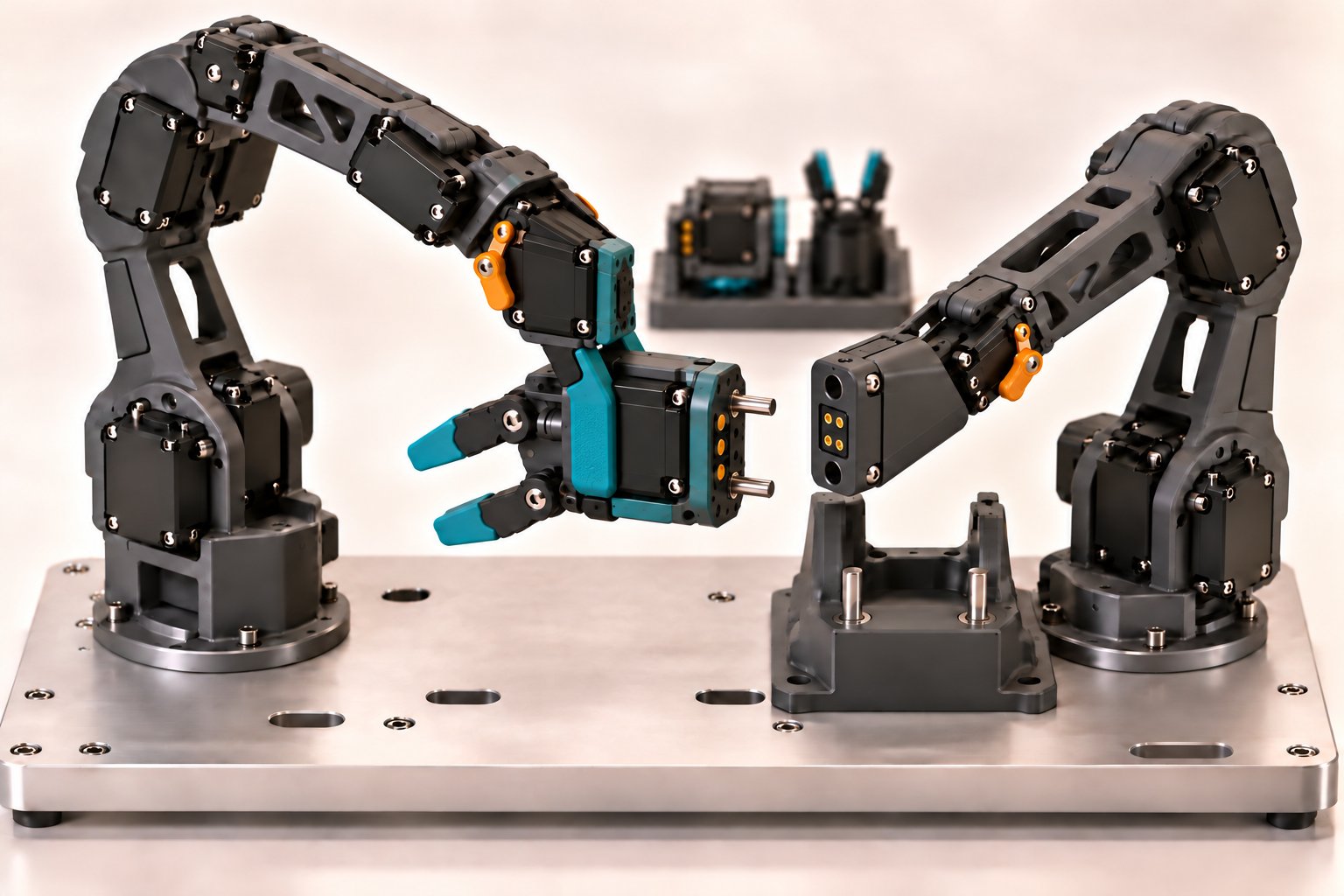
Latest corrected source concept visualization: the healthy tool clamps the replacement’s rigid housing, leaving its jaws and mating interface clear. This is a design visualization, not built hardware.
Service is an operating mode
GRAFT R1 explores two powered tabletop arms that can exchange terminal modules for one another. Each accepts the same complete gripper cartridge. Health, reachability, and compatible spare availability determine which arm acts as repairer.
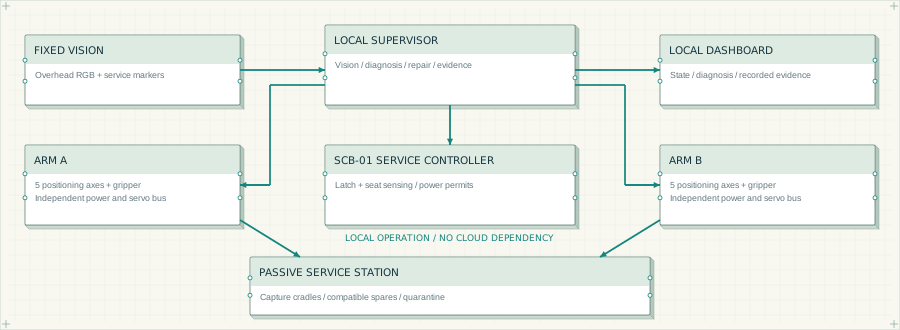
The product architecture includes the fixed camera, local supervisor, capture fixtures, supported spare rack, and service controller needed to make that exchange intelligible and bounded. Independent arm power and bus paths keep a target-side fault from automatically disabling the repairer.
The coupling carries the system contract
Locate, seat, and lock
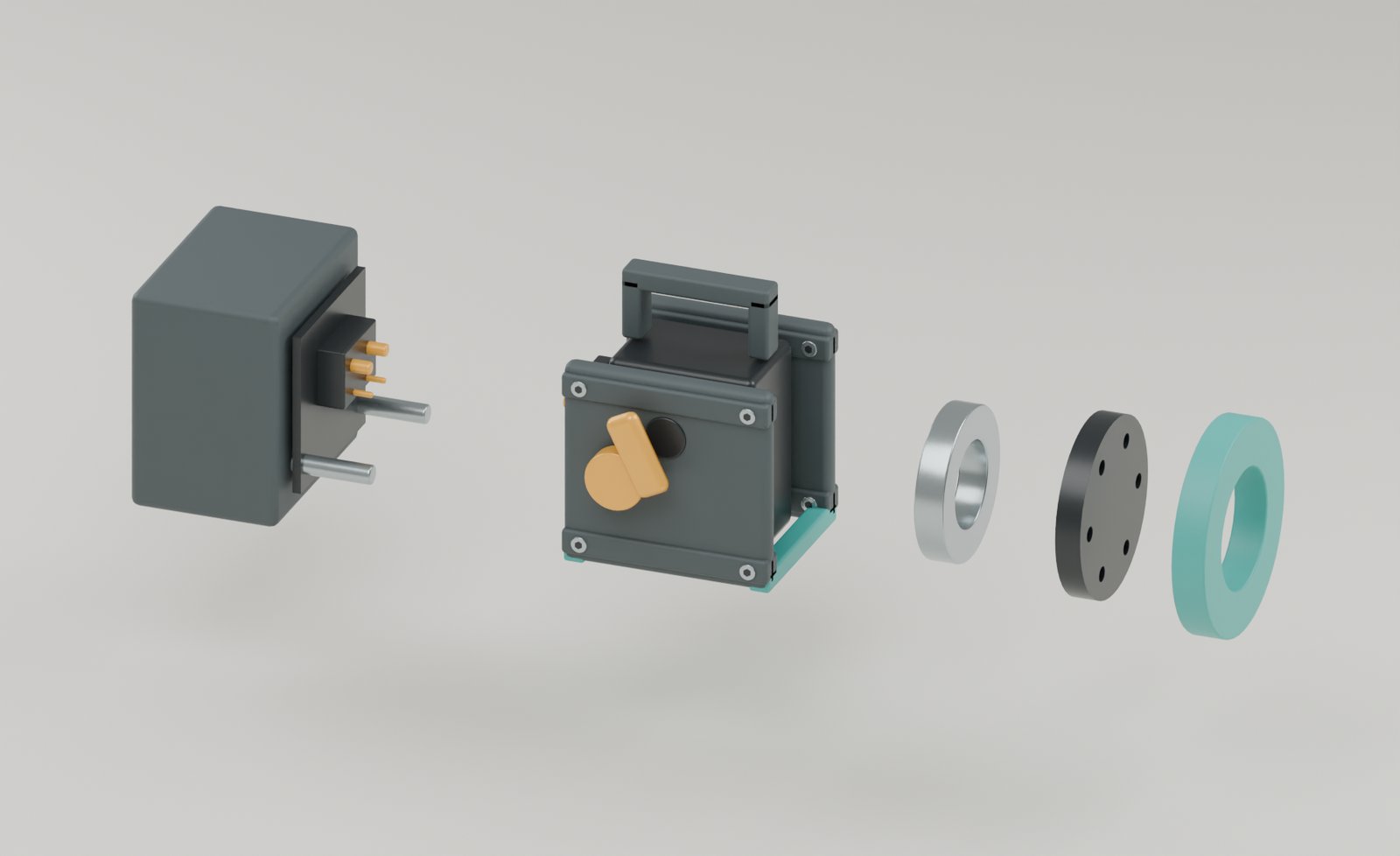
Male guide pins on the replacement align with sockets on a shallow passive receiver. A captive lock retains the assembly. Seat and lock observations must agree before power is requested. The mechanism is supported before isolation or removal.
Keep mating power off
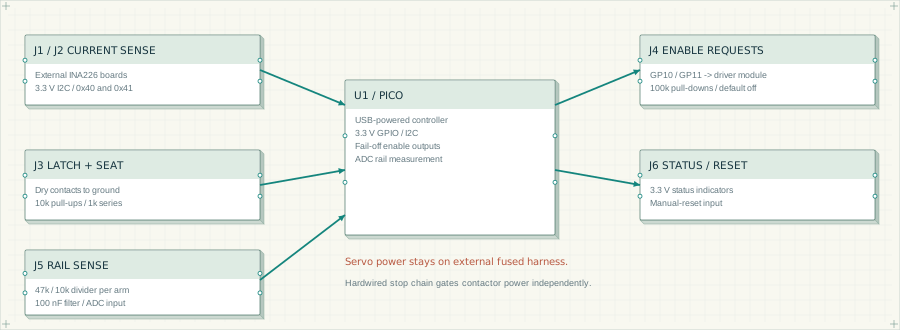
The service controller observes the target rail and controls power permission separately from arm motion. A fresh request, accepted assembly state, valid interlocks, and a fault-free controller are prerequisites. Exchange state blocks target power.
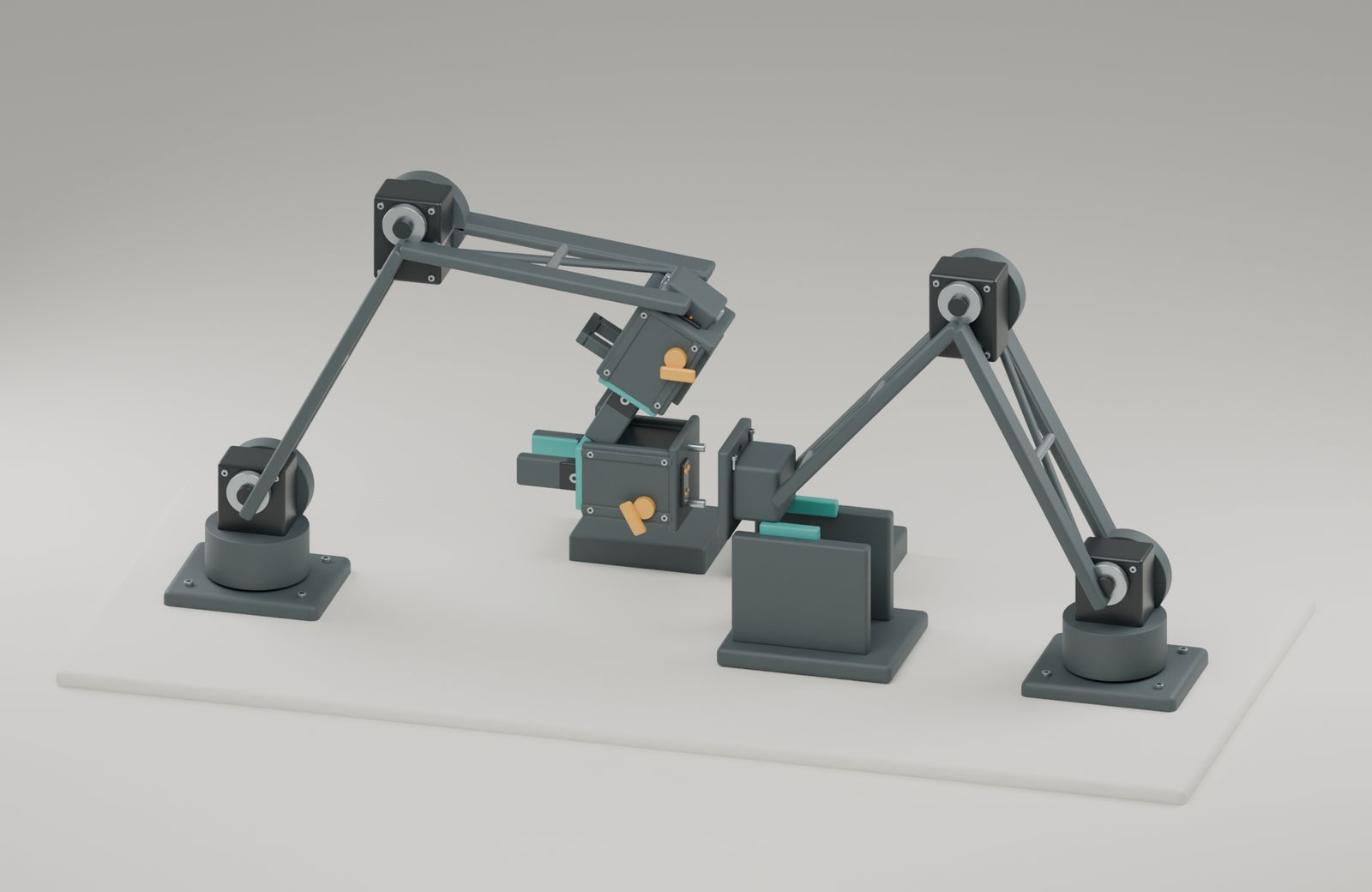
Editable geometric reference with one G1 model instanced twice. It defines assembly identity and pin/socket relationships; the corrected hero uses a revised housing grasp.Exploded wrist reference from the supplied Blender scene. Nominal geometry explains the interfaces; strength, tolerance, fit, and interference remain unqualified.
Original vector engineering plate from the source dossier. Local motion, perception, supervision, and evidence have distinct responsibilities.
Bound the recovery procedure
The local supervisor advances a deterministic repair sequence: establish support, isolate, remove, verify spare identity, insert, confirm the assembly, request power, and validate the recovered function. Uncertain diagnosis, lost required perception, incompatible identity, or unsuccessful calibration leads to a supported stop.
The design allows two controlled insertion attempts. Recovery is completed by bus identity checks, low-speed reference moves, endpoint comparison against visual datums, and repetition of the interrupted task. Motion alone does not close the repair.
Original SCB-01 functional schematic. The baseline is a COTS controller and perfboard assembly; it is not a custom PCB fabrication release.
A reviewable mechanical and software baseline
The source package includes native Blender scenes, reference meshes, vector schematics, coordinate-frame definitions, service states, and local software responsibilities. The latest assembly separates the identical complete gripper modules from the passive receiver. Contained wiring and bounded joint travel are part of the selected configuration.
What physical development must resolve
Qualify joint loads, printed structure, guide-pin fit, latch retention, and service reaction forces.
Bind logical electrical assignments to exact connectors, wire gauges, protective devices, and continuity tests.
Test rail isolation, backfeed, freshness timeouts, and stopped-state behavior on real electronics.
Measure recovery across damaged modules, uncertain poses, incompatible spares, and unsuccessful insertion cases.
GRAFT is a narrative design study. The source’s numerical test record is illustrative and is not presented as measured performance. Image-generated industrial design and editable Blender references explain intent; they are not fabrication-ready CAD, physical prototypes, or verified service capability.
Source basis: GRAFT R1.6 Design Dossier, Source Package, and latest corrected GRAFT R1 Visuals, 14 October 2026.
Developing a product with demanding subsystem interfaces?